Thursday, March 8, 2007

Exercise slows decline in Alzheimer's patients

I can attest, exercise makes a difference. My mother now has the tendency to sit around all day. On those days when I can get her to go to Gold's Gym with me she is a completely different person. The look on her face, from dull to smiling, is more than enough to tell me that exercise works to her benefit.

The article on the next page talks about the effects of exercising on Alzheimer's patients.

"Nursing home residents with Alzheimer's disease who participate in a moderate exercise program have a significantly slower deterioration than those who receive routine medical care, researchers have shown."


Exercise slows decline in Alzheimer's patients

NEW YORK (Reuters Health) - Nursing home residents with Alzheimer's disease who participate in a moderate exercise program have a significantly slower deterioration than those who receive routine medical care, researchers have shown.

Dr. Yves Rolland, of Hospital La Grave-Casselardit in Toulouse, France, and colleagues examined the effects of a program of exercise for one hour twice weekly on activities of daily living, physical performance, nutritional status, behavioral disturbance and depression among 134 Alzheimer's disease patients in nursing homes.

The patients were 83 years old on average. They were assigned to the exercise program, which focused on walking, strength, balance and flexibility training, or to routine medical care for 12 months.

As reported in the Journal of the American Geriatrics Society, 110 participants completed the study. Among the 56 subjects in the exercise group who completed the study, the rate of adherence to the program was about 33 percent on average.

At the end of the 12 months, the average activities-of-daily-living score was significantly more improved in the exercise group than in the routine medical care group, Rolland's team reports.

In addition, average walking speed improved significantly more in the exercise group than in the routine medical care group at 6 months and 12 months.

However, the exercise program had no apparent effect on behavioral disturbance, depression or nutritional assessment scores.

ORIGINAL SOURCE: Journal of the American Geriatrics Society, February 2007.
For more Insight into Alzheimer's Disease
Subscribe to The Alzheimer's Reading Room


Bob DeMarco is an Alzheimer's caregiver and editor of the Alzheimer's Reading Room. The Alzheimer's Reading Room is the number one website on the Internet for advice and insight into Alzheimer's disease. Bob taught at the University of Georgia, was an executive at Bear Stearns, the CEO of IP Group, and is a mentor. He has written more than 700 articles with more than 18,000 links on the Internet. Bob resides in Delray Beach, FL.

More from the Alzheimer's Reading Room


Follow the Alzheimer's Reading Room on Twitter

Sunday, February 25, 2007

Alzheimer's--Feeling Abandoned?


You should consider asking your parent(s)if they are lonely. See how lonely seniors answered on the next page.


FEELING ABANDONED?

New research suggests lonely people are at greater risk of developing dementia. Seniors who scored high on the loneliness quiz agreed with three or more of the following scenarios:

• I experience a general sense of emptiness.

• I miss having people around.

• I feel like I don't have enough friends.

• I often feel abandoned.

• I miss having really good friends.

Source: Robert Wilson at the Rush University Medical Center in Chicago

Friday, February 9, 2007

My Mother


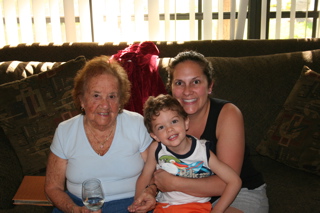
This is a picture of my mother Dorothy who is 90 years young, Kristen my mother's granddaughter, and Ryan her greatgrandson.

This picture was taken in Boca Raton, Florida, May, 2006.

Tuesday, January 2, 2007

I just wanted to scream, STOP! Part One

I can still remember the day. An experience that told me: you are not alone; it’s all about the disease. An experience that let me know I could learn from the experience of others that came before me. That it would be possible for me to get ahead of the curve and get “mentally” prepared.

I can still remember the day. An experience that told me: you are not alone; it’s all about the disease. An experience that let me know I could learn from the experience of others that came before me. That it would be possible for me to get ahead of the curve and get “mentally” prepared.

In the beginning one of the things that drove me crazy was my mother’s constant eating. My mother would just eat and eat and eat. Even though she was overeating she would tell her friends on the telephone that she had not eaten a thing all day. And, this was at 4:30 in the afternoon. It seemed that the more she ate the more she denied eating. And it only continued to get crazier and crazier. My mother who was a good 30 pounds overweight told her friends I was trying to starve her. The friends believed her. They called me in the background to ask me why I wasn’t feeding my mother. They couldn’t accept she was suffering from Alzheimer’s disease so they believed her. When I asked them if it looked like she was being starved they just did not know how to respond. They just got confused. They knew then it wasn’t true.

It might not be easy to envision this but my mother could eat a five course meal and then turn around and eat again in 30 minutes. This happened for the first time on Easter Sunday. We went to a buffet style brunch at the Delray Country Club. My mother had everything that day ranging from a ham and cheese omelet, to a slice of prime rib, turkey, potatoes, and even a couple of desserts. When we arrived home she changed her cloths and ate a large bowl of cereal with a banana. I had been thinking to myself that I was going to be unable to eat anything for the rest of the day. Seeing her eating the cereal drove me crazy, literally up the wall. This was becoming a common experience for me. It left me angry, confused and completely out of sorts. I just wanted to scream, Stop!

I am not talking about a gigantic woman. Before the Alzheimer’s really started taking hold, I doubt her weight fluctuated more than five to seven pounds over the previous 15 years. She wore a size 6-8 all those years.

Now, it was not unusual for my mother to eat at 11:30 at night, to get up out of bed and eat at 1:30 in the morning and 4.27 AM. She would eat breakfast at 7 AM and again at 9. She would eat lunch, several snacks, and everyday at 4:30 in the afternoon shortly after I reminded her that we would be eating dinner in half an hour--a sandwich. You could set your clock to the time of day. I could go out into the kitchen and just wait for her or better yet just perk my ears up at 4:30 and listen for the refrigerator to start beeping. Later she would have dinner and begin the cycle all over again beginning around 9 o’clock at night.

This pattern of eating was driving me crazier and crazier. My tiny 5 foot tall mother had ballooned to 152 pounds. I knew this was dangerous to her health (she was developing visceral fat and this can be life threatening). She could barely walk to the mailbox and back. It was causing her to become more and more sedentary. It was a vicious cycle. I didn’t know what to do or where to turn.

Finally, I decided to get us into the gym for some exercise (my own weight had ballooned all the way up to 206). As I was thinking about how I might accomplish this mission we received a flyer in the mail from my mother’s healthcare provider (Humana). It was almost as if I was receiving an answer to a prayer: the Silver Sneakers Program. The flyer announced that on January 1, 2005 all Humana Gold Plus members would be eligible for a free membership to a gym and enrollment into a exercise program specifically designed for Senior citizens. I enrolled my mother into the Silver Sneakers Program (SSP) and bought myself a two year membership to Gold’s Gym in Delray Beach. Since the SSP was offered at Gold’s this allowed us to go to the gym and to work out at the same time. And this is where it happened.

Next time Part 2. Some startling realizations, the end of denial, the beginning of an understanding of the behavior around the disease, and my own mental construct of how to deal emotionally with the behavior.

Thursday, December 28, 2006

Why Didn't I Get It?


The signs were there but no one could see them--not even me.


Why Didn't I Get It?

I was talking to my sister one evening and she said to me, “You better call Mom she says she hasn’t talked to you in months.” I laughed and said I talked to her two days ago and for more than an hour. Later in the evening, I decided to call my mother. After she recognized my voice she said, “Well its about time you called.” When I said I just talked to you two days ago she just shrugged it off and we began our usual conversation.

I really don’t know why I wasn’t more concerned at the time but to be honest I wasn’t. And neither was anyone else. The typical comment, “she sounds good to me.” I guess like most people I just accepted the fact that she was getting old. Nobody saw a problem not even her friends who saw her on a daily basis.

Looking back there were plenty of signs. For one thing, she was developing a very negative attitude. But, it seemed when I spent time with her, a few days, she would turn back into her normal self and start to have a more positive outlook on things. Another sign occurred when she began to scrape her feet as she walked. I suppose I should have concluded something but I didn’t. We thought she was finally slowing down. I could go on and on.

Then Christmas came and I decided to take her shopping. To my surprise she could barely walk for five minutes without stopping. In fact, she was almost slumping over. Out of the clear blue sky, or so it seemed, she just couldn’t walk any distance and it was struggle just getting her back to the car. Clearly something was a-muck.

I went to talk to her doctor. Other than her high blood pressure, her heart was fine and her overall blood work was pretty good—more than pretty good for a woman her age. Keep in mind we are talking about an 87 year old woman at the time, a woman who had never had a major illness or operation her entire life. The closest she had come to any of that was when she had an operation on a bunion on her foot.

Yet now for some reason she was no longer able to walk comfortably. I began to notice how she was somewhat unsteady, how she began to reach out and hold on to things as she walked, and how she no longer had an interest in doing anything that required her to walk. Two years earlier this woman, my mother, walked more than a mile round trip with me in New York to eat breakfast.

My Mother the Dynamo


My mother at the age of 85 was a dynamo. She lived on her own, paid her own bills, and took care of herself.......


My mother at the age of 85 was a dynamo.
She lived on her own, paid her own bills, and took care of herself. She had been doing this for more than ten years since the death of my father. She was on her own.

My mother was often spotted walking to the pool in her community. A tiny women the senior citizens all around her marveled. It seemed as if father time had forgotten about her. There was no limit to what she could do. Walk 20 blocks, no problem, you name it. Up at dawn and awake at midnight she was a real dynamo.

My mother was very funny, a real character. She made people laugh and smile. She read the paper and watched CNN, she had opinion on everything and wanted to know your opinion. She was a wonderful person: always welcoming people into her home. She was noted for all of my 50 years for her great Italian cooking. I remember as a kid that all of my friends really looked forward to staying over our house. Donuts, spaghetti and meatballs you name it. Ravioli anyone?

Me? I was there with my mother when my fathered "passed away'; this was when I really started about her longevity, her health. I was thinking about her for years knowing that someday she had to live with one of us (I have a brother and sister). As the years flew by I started to think about it more and more. But she just kept going ang going without a health problem of any kind. Rarely a minor illness. She was the real energizer bunny.

At times, my brother, sister and I had discussions about putting my mother into some kind of "facility". But to be honest, to be honest now, I knew I would never be able to do it. While I had only mentioned it to a few people, I had made a promise to my father not long before he died. I promised him no matter what, I would take care of his wife of 55 years, my mother, our love. Dot. It was not a promise I made haphazardly. I made up my mind about this while we were taking care of my dying father. It seemed as natural to me as breathing. I already knew in my mind and my heart, I was the one.

I knew the day would come. I just didn't know when. Or how.


Maybe I Should Have Known

I should have started this three years ago. My, how time flies. I have a lot of catching up to do for sure so just bear with me. Some days I’ll go back to the beginning and tell you our story. On other days I will tell you what is happening on the spot. I’ll vent about my mother. If she is up to it I will encourage her to tell you in her own words what is going on in her head.......

I became a CareGiver before I had any idea that the word existed. It all started back in late 2003 after a series of strange occurrences by my mother. I guess I should have known when my mother ran her car over an abutment and scraped off the entire side of her car on a tree. Me, more than 1000 miles away, I was told the car was not that bad. Two days later and on the scene, I found out the car was totaled. Fortunately, my little tiny five foot tall, 87 year old mother was just fine. At least that is what she and all the doctors told me. While I accepted it at the time I just knew something was not right. And this is where the story about me and my mother begins.

I am just beginning this Blog. If you somehow found me, welcome. Please feel free to say 'hi". If you are a care giver or if you believe you have something to add please feel free to do so. If you have comments make them.

Ok then, this is our story.

Bobby


All American Senior Care